.png)
The Complete Beginner's Guide to Understanding Wet Mix Macadam and Its Role in Highway Engineering
- Coninfra Machinery
- 2 days ago
- 6 min read

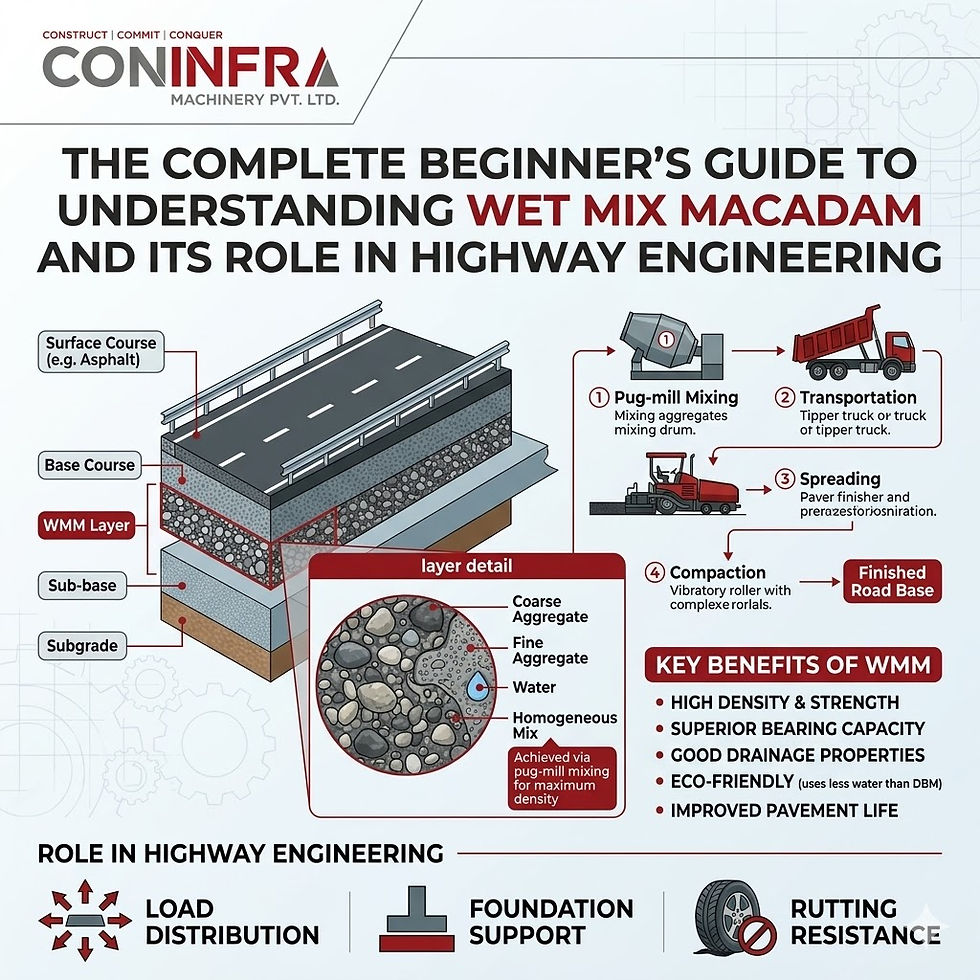
If you are new to road construction or looking to strengthen your foundational knowledge, understanding wet mix macadam is a great place to start. WMM is one of the most widely used base course materials in highway construction across India, especially in states like Gujarat where infrastructure development is moving at a rapid pace. It provides the structural strength that roads need to carry heavy traffic loads over long periods without premature failure.
This guide breaks down everything from what WMM actually is to how it is laid, what machines are involved, and what it costs.
What Is Wet Mix Macadam and Why Does It Matter
Wet mix macadam is a road base material made by combining crushed aggregates with water in a controlled and uniform manner before compaction. Unlike dry methods, the wet mixing process ensures better binding, improved density, and a more consistent surface that supports the layers above it.
In highway engineering, the base course plays a critical role. It distributes the load from vehicle traffic down to the subgrade and protects it from damage. WMM is the go-to choice for this layer because of its proven performance in diverse climatic and traffic conditions.
According to the Indian Roads Congress (IRC SP 20), wet mix macadam is recommended as a preferred sub-base and base course material for rural and national highways because of its strength and durability under varying conditions.
How Wet Mix Macadam Is Different From Dry Macadam
Many beginners confuse WMM with Water Bound Macadam (WBM). Here is a simple breakdown:
WMM uses a wet mix macadam mixer to pre-mix aggregates and water before laying
WBM involves placing dry aggregates and then watering them on the road itself
WMM offers better quality control, faster execution, and more uniform gradation
WMM road construction is less labor-intensive and more suitable for modern highway projects
The shift from WBM to WMM in Indian highway projects reflects the industry's push toward better standards and mechanized execution.
Understanding the Wet Mix Macadam Mix Design
Getting the mix design right is critical to performance. A poorly designed mix can lead to rutting, cracking, or base failure within just a few years.
Key Parameters in WMM Mix Design
Aggregate gradation must meet IRC standards, typically Zone A or Zone B grading
Optimum moisture content is determined through lab tests to achieve maximum dry density
Aggregate quality including flakiness index, elongation index, and Los Angeles abrasion value must be within permissible limits
Fines content must be controlled to avoid excess plasticity in the mix
A well-designed wet mix macadam mix design ensures the base course achieves the required California Bearing Ratio (CBR) value, which is essential for pavement design calculations.
Common Mistakes to Avoid
Using aggregates with high dust content without testing
Ignoring moisture variation during field laying
Skipping compaction trials before full-scale execution
The Role of a Wet Mix Macadam Laying Machine
Modern WMM road construction relies heavily on mechanized equipment. Manual laying is no longer considered acceptable for national or state highway projects.
What a WMM Laying Machine Does
A wet mix macadam laying machine, commonly called a paver finisher, spreads the pre-mixed material uniformly at the required thickness. It comes with a screed that controls the level and texture of the laid surface.
Key features to look for in a laying machine:
Automatic grade and slope control
High-capacity hopper for continuous laying
Vibrating screed for better compaction
Compatibility with WMM material gradation
Pairing It With the Right Compaction Equipment
After laying, the surface must be compacted using a vibratory roller. The number of passes required depends on the compaction trial results. Typically, a combination of a smooth wheel roller and a pneumatic tyre roller is used to achieve the required density.
Wet Mix Macadam Mixer: The Heart of the Operation
The wet mix macadam mixer is the central piece of equipment in any WMM project. It blends crushed stone aggregates with a precise quantity of water to produce a homogenous mix ready for laying.
Types of WMM Mixers
Pug mill type mixer — the most common type used in India, known for consistent output
Twin shaft mixer — used for higher capacity requirements
Mobile wet mix plant — ideal for projects in remote locations where transporting material is difficult
Choosing the right mixer capacity depends on your daily laying targets, haul distance from the plant to the site, and project timeline.
If you are based in Ahmedabad or Gujarat and looking for reliable WMM plant solutions, it is worth evaluating local manufacturers who understand regional aggregate characteristics and project demands.
Cost of WMM Road Construction: What to Expect
One of the most common questions from contractors and project managers is about the cost of WMM road construction. While exact figures vary by location, material availability, and project scale, here is a general framework.
Factors That Affect WMM Road Construction Cost
Aggregate cost — varies by source, transportation distance, and quality
Plant mobilization — setting up and transporting the wet mix plant
Labour and equipment hire — operators, rollers, and paver finishers
Compaction trials and quality testing — mandatory for most government projects
Royalty and GST — applicable on material sourcing
Approximate Cost Range
For Indian highway projects, the cost of WMM road construction typically ranges between ₹800 to ₹1,400 per square meter depending on thickness, location, and procurement efficiency. Always get detailed rate analysis done before budgeting.
Quality Control in WMM Road Construction
No guide on wet mix macadam is complete without covering quality. Poor quality control is the single biggest reason for premature road failure.
Field Tests You Should Not Skip
Core cutting test — to verify compacted thickness
Sand replacement test or nuclear density gauge — to confirm field density
Moisture content check — before and during laying
Aggregate gradation test — to ensure compliance with IRC specifications
Maintaining proper records of these tests not only ensures quality but also builds trust with clients and government bodies.
Why WMM Continues to Dominate Indian Highway Projects
Despite newer materials entering the market, WMM road construction remains the standard for base course work in India for several reasons:
It is cost-effective compared to alternatives like Dry Lean Concrete (DLC)
The material is widely available across India
Equipment is accessible and operators are trained
IRC specifications are well-established and accepted by all government agencies
It performs well across different soil types and traffic loads
For contractors in Ahmedabad and Gujarat working on state or national highway projects, WMM remains one of the most practical and proven choices for base course construction.
FAQs:
Q1. What is wet mix macadam used for in road construction?
Wet mix macadam is primarily used as a base course layer in highway construction. It provides structural support between the subgrade and the bituminous surface layers, distributing traffic loads evenly and improving the overall durability of the pavement.
Q2. How is wet mix macadam different from water bound macadam?
WMM uses a mechanical mixer to blend aggregates and water before laying, ensuring uniformity. WBM involves dry laying of aggregates and watering on-site. WMM offers better quality control, faster construction speed, and superior performance under heavy traffic conditions.
Q3. What is the standard thickness of a WMM layer?
As per IRC guidelines, a single WMM layer is typically laid at a compacted thickness of 75mm to 100mm. For projects requiring greater base thickness, multiple layers are laid and compacted individually to maintain quality and density standards.
Q4. What machinery is required for WMM road construction?
WMM road construction requires a wet mix macadam mixer or plant, a paver finisher for laying, vibratory rollers for compaction, and water tankers for moisture control. Quality testing equipment like nuclear density gauges and sieve sets are also essential on site.
Q5. What is the approximate cost of WMM road construction in India?
The cost of WMM road construction in India generally ranges from ₹800 to ₹1,400 per square meter depending on layer thickness, aggregate availability, location, equipment mobilization costs, and project scale. Detailed rate analysis is recommended before project budgeting.
Q6. How do I choose the right wet mix macadam mixer for my project?
Choose a WMM mixer based on your required daily output, project duration, and site accessibility. Pug mill mixers are ideal for most highway projects. Mobile wet mix plants work well for remote sites. Always match plant capacity with your paver laying speed to avoid material delays.
Q7. Is wet mix macadam suitable for rural roads?
Yes, WMM is widely recommended for rural road construction under schemes like PMGSY. It is cost-effective, durable, and suitable for low to medium traffic rural roads. Proper mix design and compaction ensure long-term performance even in challenging soil and climate conditions.


Comments